Saturday, November 7, 2015

#Metrojet #9268 #7K9268/ #KGL9268: Why this rhetoric about a bomb?


#Metrojet #Flight9268 (#7K9268/ #KGL9268), an international chartered passenger flight operated by Russian airline Kogalymavia (branded as Metrojet), crashed in northern Sinai on 31 October 2015 at 06:13 EST (04:13 UTC) following departure from Sharm el-Sheikh International Airport, Egypt, en route to Pulkovo Airport, Saint Petersburg, Russia. ISIS was quick to claim that it brought the airliner down. After initially discarding this claim as Propaganda, we are now being told that the flight was brought down by a bomb.

But before you become alarmed, and accept these claims at their face value, please listen carefully. The statement from the office of British Prime Minister DOES NOT state that the flight was brought down by a bomb, but only that “…We CANNOT BE CERTAIN that the Russian airliner was brought down by a bomb, but because it’s a STRONG POSSIBILITY, its right to act…”  Statement from his office also uses the words "...MAY have been brought down by an explosive device..."


In a radio interview with Seattle-based KIRO Radio, Obama said, “I think there is a POSSIBILITY that there was a bomb on board and we’re taking that very seriously.”

The media has gone viral with the bomb theory, but my attempt in this blog has always been to separate the fact from fiction/ propaganda and to present to my readers an unbiased view so you can make your own decision on what might be the truth and what merely motivated reporting for political mileage or TRPs. So, what is the truth here?

The tail of the aircraft is, in my opinion, at the center of all controversy, and also all evidence, in this case.

https://www.createspace.com/4583791

Notice here the very clean break, along the bulkhead joint at the top, with no sign whatsoever of any jagged tear, heat stress or fire. The fin and aft fuselage were about 5 km south of the wing and rest of the fuselage and also about 2.5 Km south of the last radar position. Given that the aircraft was travelling on a generally Northerly track, this indicates that the tail came off first. The photo above shows a clean lateral break at a frame at the top indicating that is where the fracture started and the complicated rupture at the bottom being the final departure from rest of the aircraft as the back end bent off downwards. That would indicate the failure was due to an excessive download force on the horizontal stabilizer or a fatigue failure at the fuselage top adjacent the frame. Following this, pressurization would blow the back end off. Either way, rest of the aircraft would have been pushed forward with an impulsive thrust of a few thousand pounds as the pressurized air released out the back like a rocket exhaust. This would also account for the aircraft skin peeling off outwards seen in some pictures in the press.

The question that begs an answer is, “Why there is such a clean break with no sign of heat stress or fire if this break-up was the result of a bomb?” As can be seen from various images published in the press, fire was localized to the main fuselage body, the section that houses the wings (where most of the fuel is stored) and the central fuel tanks.

http://www.amazon.com/dp/B00HGRNN1I

Inflight break-ups because of structural failure are extremely rare, but have happened in the past. Japan Airlines Flight 123 was a scheduled domestic passenger flight from Tokyo's Haneda Airport to Osaka International Airport, Japan. On Monday, August 12, 1985, a Boeing 747SR operating this route suffered explosive decompression 12 minutes into the flight and, 32 minutes later, crashed into two ridges of Mount Takamagahara in Ueno, Gunma Prefecture, 100 kilometres (62 miles) from Tokyo. The explosive decompression was caused by a faulty repair performed seven years earlier. About 12 minutes after takeoff, at near cruising altitude over Sagami Bay, the aircraft's aft pressure bulkhead burst open due to a pre-existing defect stemming from a panel that had been incorrectly repaired after a tailstrike accident years earlier. This caused an explosive decompression, causing pressurized air to rush out of the cabin, bringing down the ceiling around the rear lavatories. The compressed air then burst the unpressurized fuselage aft of the bulkhead unseating the vertical stabilizer and severing all four hydraulic lines. A photograph taken from the ground some time later confirmed that the vertical stabilizer was missing.

https://www.createspace.com/4888847

China Airlines Flight 611 (callsign Dynasty 611) was a scheduled passenger flight from Chiang Kai-shek International Airport (now Taiwan Taoyuan International Airport) in Taiwan to Hong Kong International Airport in Hong Kong. On 25 May 2002, the Boeing 747-209B operating the route disintegrated in mid-air and crashed into the Taiwan Strait 20 minutes after takeoff, killing all 225 people on board. The in-flight break-up was caused by improper repairs to the aircraft 22 years earlier. The final investigation report found that the accident was the result of metal fatigue caused by inadequate maintenance after an earlier tail strike incident. On 7 February 1980 while landing in Hong Kong, part of the plane's tail had scraped along the runway for several hundred feet. The aircraft was depressurized, ferried back to Taiwan on the same day, and a temporary repair done the day after. A more permanent repair was conducted by a team from China Airlines from 23 May through 26 May 1980. However, the permanent repair of the tail strike was not carried out in accordance with the Boeing Structural Repair Manual (SRM). The area of damaged skin in Section 46 was not removed and the repair doubler plate that was supposed to cover in excess of 30 percent of the damaged area did not extend beyond the entire damaged area enough to restore the overall structural strength. Consequently, after repeated cycles of depressurization and pressurization during flight, the weakened hull gradually started to crack and finally broke open in mid-flight on 25 May 2002, coincidentally 22 years to the day after the faulty repair was made upon the damaged tail. An explosive decompression of the aircraft occurred once the crack opened up, causing the complete disintegration of the aircraft in mid-air.

https://www.amazon.com/dp/B00M0ENG2I

On April 28, 1988, an Aloha Airlines Boeing 737-200 lost part of the upper fuselage on a flight from Hilo to Honolulu. It diverted and landed in Maui. The accident investigation concluded that corrosion had not been detected and caused the failure of a lap joint.

The above events, specifically those of Japan Airlines Flight 123 and China Airlines Flight 611, bear a remarkable resemblance to #Flight9268 in all aspects of the accident, including the disposition of the wreckage, the broken tail section and rudder, explosive decompression, steep near vertical drop to the ground and lack of any warning or reaction time to the crew.

So far inquiries, with the aim to receive the final report of the tail strike in 2001 as well as clarify the extent of damage and who performed the repairs to Egypt's Civil Aviation Authority Accident Investigation, Airbus, Metrojet and Middle East Airlines have not been answered. However, in a press conference the chairman of Metrojet said that the repair in 2001/2002 was done by Airbus.

The investigators have stated that the cockpit voice recorder of Metrojet Flight 9268 shows an explosion and the flight data recorder confirms the explosion is not accidental – there is no sign of mechanical malfunction during the initial part of the flight, France 2 reported. But the fact remains that the only one evidence available in the black boxes is that they stopped recording suddenly, following an explosion, without any prior warning. So, is this enough to conclude that Flight 9268 was brought down by a bomb? 

In my opinion, NO.

A failure at the tail section, that tore the tail off, would immediately also severe all electrical connections between the plane and the Black boxes, resulting in an instant loss of power and data to the recorders. They would register the explosive sound of decompression and then stop all recording due to loss of power and data connection as a result of this break-up. This is not evidence that the break-up occurred due to a bomb, but only that a break-up occurred! The evidence of a bomb needs to come from explosive traces and heat stress/damage that would occur at the site of the explosion…and at this time that vital evidence is still missing. The post mortem reports have not yet yielded any evidence of explosive traces on the bodies and the investigators have also not yet located any such residue on the aircraft structure from the tail section. There are also no visible signs of any nature of heat or fire damage to the tail section.

It is interesting that while the investigation is being led by Egyptian authorities with Russian and French collaboration, the statements have come from French investigators and the UK and US governments who do not even have investigators on ground; France is the home state of the aircraft manufacturer, Airbus! One wonders if there is an attempt here to shield the manufacturer from any possible liability due to failed repairs it carried out on the tail section way back in 2001? One also wonders if the UK and USA and other western powers have a motivated interest here to raise this rhetoric in order to link this issue with Russian involvement in Syria and then use this as leverage against Russia? Or is it merely an excuse to increase security expenditure and restrictions? Either way, it is a very deplorable and manipulative manner of taking undue advantage of a tragedy!

To me, as an accident investigator who takes pride in Aviation industry’s ability to investigate accidents to the root cause impartially and in an unbiased manner, in order to bring about corrective measures to prevent another, the manner in which the press and western leaders are responding to this event, as well as earlier responded to #MH17 accident is a serious cause for concern. I wonder if, like #MH17, the real truth about #Metrojet #Flight9268 will ever be known!


Sunday, August 9, 2015

#Phenom300 #HZ-IBN accident on 31 July: The Erring Human Strikes Again!

An #Embraer #EMB-505 #Phenom300 jet was destroyed when it crashed into a car auction next to Blackbushe Airport, U.K., killing all four occupants. UK AAIB has opened an investigation into the accident and a special bulletin was published on 06 Aug 2015 that can be downloaded from this link.

https://www.gov.uk/aaib-reports/aaib-special-bulletin-on-phenom-300-hz-ibn

HZ-IBN just seconds before crash (Photo by Geoff Pierce)
In summary, #HZ-IBN, entered the left-hand circuit for runway 25 at #Blackbushe via the crosswind leg. Towards the end of the downwind leg, it overtook a micro light aircraft, before climbing slightly to pass ahead of and above that aircraft. Several TCAS Resolution Advisories were issued to the pilot during the manoeuvre.
Following this climb, HZ-IBN then descended at up to 3,000 feet per minute towards the threshold of runway 25. When HZ-IBN was 1.1 nm from the runway threshold it flew at 1,200 feet above airfield level at a speed of 146 KIAS, with the landing gear down and flap 3 selected. The target threshold speed for the aircraft was calculated to have been 108 KIAS.
The aircraft continued its approach at approximately 150 KIAS. Between 1,200 and 500 feet the rate of descent averaged approximately 3,000 fpm. The aircraft’s TAWS generated six ‘pull up’ warnings on final approach. The aircraft crossed the threshold of runway 25 at approximately 50 feet at 150 KIAS.
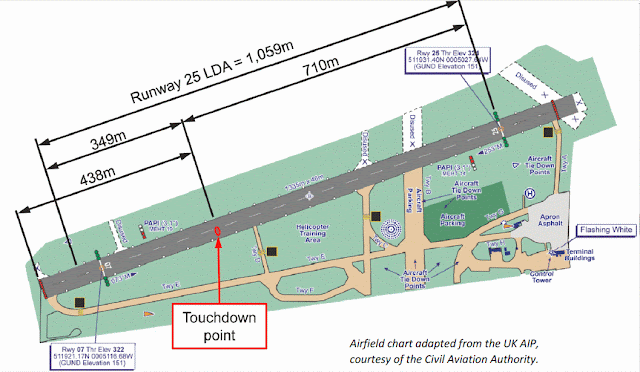
Tyre marks made by the aircraft at touchdown indicated that it landed approximately 710 m beyond the runway 25 threshold. Runway 25 has a declared Landing Distance Available (LDA) of 1,059 m; therefore the aircraft touched down approximately 349 m before the end of the declared LDA, 438 m before the end of the paved runway surface. The airspeed on touchdown was still 134 KIAS. At this speed the landing ground roll required to stop the aircraft would be at least 616 m.
https://www.gov.uk/aaib-reports/aaib-special-bulletin-on-phenom-300-hz-ibn


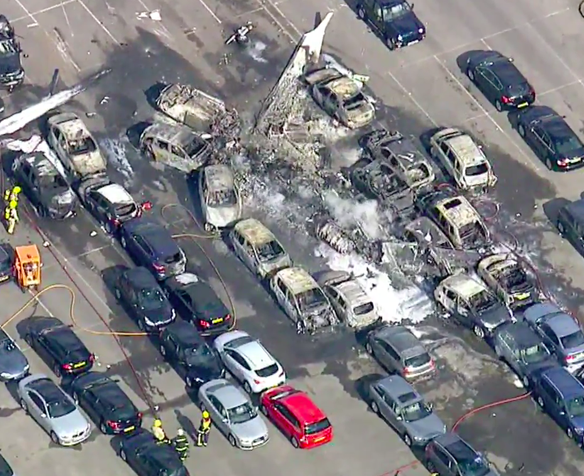
The aircraft departed the paved surface at the end of runway 25 approximately three metres to the left of the extended runway centreline. It then collided with a one-metre high earth bank causing the lower section of the nose landing gear and the nose gear doors to detach. The aircraft became airborne again briefly, before colliding with several cars parked at an adjacent business and coming to rest approximately 70 metres beyond the earth bank. The aircraft’s wing detached from the fuselage during the impact sequence and an intense fire developed shortly thereafter, consuming the majority of the aircraft. All the four occupants including the Captain, flying solo, were killed in this accident.
https://www.createspace.com/4583791

It is clear from the above discourse that the approach was un-stabilized and should never have been continued. Yet, it was. The Captain was 57 years old with over 11,000 hrs. of total experience (of which 1,180 hrs. on type), and was personally known to me. He had participated in many training sessions on SMS and CRM conducted by me. I had also been involved in development of both, the operations and the SMS manuals, for the operator as a part of their IS-BAO certification in 2011. In this sense, I feel deeply affected by this tragedy. He was not a reckless man. Yet, he seemingly continued an un-stabilized approach and the comment from his employer, “…Such an experienced Pilot! How could he!” shocks me more than anything else about this tragedy.
The comment is a reflection of total lack of understanding of Human Factors in aviation operations. This in itself gives us a clue on why this accident happened and how a well-qualified, properly trained and experienced human was forced to err! This accident is also an almost exact replica of the #IX812 crash I had written about in my book “Waiting…To Happen!” and has occurred for almost the same reasons! Un-stabilized approach, very high rate of descent, very high landing speed, touchdown 2/3rd way up the runway with not enough runway left to stop the aircraft…the sequence is eerily similar!
http://www.amazon.com/dp/B00HGRNN1I

Human error is a symptom, not a disease. It is a start point of an investigation, not its conclusion. All human performance happens inside an organizations policies and procedures. It is those policies and procedures that set in motion a “latent conditions” trajectory, setting in motion a chain of events that culminates into a human making an error and ultimately an accident. The aircraft was not being operated in an individual capacity, but under the AOC of a company and following the policies and procedures as set by the management team. An accident of this nature is a clear evidence of the management team’s failure to manage the aircraft and to ensure safe operation of its aviation assets. It is clear that the Operations and SMS manual contents were not being applied on ground in their letter and spirit. It is not enough to have a good manual. It is important to be able to understand that manual and then apply it, consistently and judiciously, in the company’s daily operations. It is painfully evident that the company failed it its objective of consistent and judicious management of safety. The accountability for Safety Management rests with the Accountable Manager, in this case the Managing Director, and that is where the questions need to be raised. This is a failure of the Managing Director to manage safety, and he has a lot to answer for!
Management of safety does not happen by making statements like “Safety First” and “Safety is Everyone’s Business”. Safety is NOT everyone’s business. It is the business of the Accountable Manager, and Accountable Manager alone. By making a statement like “Safety is Everyone’s Business” the Accountable Manager seeks to escape his responsibility and creates a situation where somebody should do something, everybody could do something, but nobody does anything! Instead, the Accountable manager would do well to lead by example and take the bull by its horns by owning-up his responsibility, accountability and his failure. Things need to be set right by acknowledging that “safety first” is wrong notion to perpetuate. No organization, not even ICAO, was formed totally and only for safety. Every organization has a primary objective of service delivery. This service must be delivered safely, but it must first be delivered! This is what needs to be understood. By making statements like safety first, the management sets in place a paradox. It creates a false feeling of security where adhoc decisions are taken in the name of safety. It is important to always remember that Safety is not accident prevention, but risk management. It is true that management of risks will prevent accidents, but that will be a corollary to the theorem. Primary focus needs to remain on management of risks rather than on prevention of accidents. The end product of the company, in this case the service, must be delivered safely; otherwise, it is not delivered at all. So, safety needs to become a way of life…the way we do things around here…identifying hazards and managing risks before any activity, implementing risk controls, allocating responsibilities, monitoring implementation of risk controls, collecting and evaluating feedback and repeating the process again, and again, and again…endlessly.
http://theerringhuman.blogspot.in/2014/12/waitingto-happen-one-year-on_22.html

For this process to work, it is important that Safety Management is managed at the same level as other business processes like Financial Management, HR Management, Marketing Management etc. The most common failure is seen in placing HR, Financial, marketing etc. in primacy over Safety Management, thereby setting in place conditions ripe for failure of the Safety process. This often happens because safety is seen as a non-productive process, an expense item on the balance sheet. Also, lack of understanding of Human Resources Management by even some HR professionals results in creation of this paradox. Humans are treated like objects. They are sought to be managed like objects. Policies and procedures are not applied across the board or consistently. These conditions create an environment where the humans see a difference in the written text and the implementable rules. They are quick to catch the difference and follow what they “perceive” to be the Managers intent! While their perception may or may not be correct, they will always do what they perceive is required by their manager rather than what was meant by the words spoken to them or text written for them. Moreover, the management keeps wondering, why the humans cannot follow simple instructions, little realizing that they are actually following the instructions they perceive rather than what they read or hear!
This is the real challenge in development of human resources. Human resources cannot be managed. They can only be developed. They can be developed by providing a leadership that leads by example. A manager who routinely flies his aircraft certified to 16,000 ft altitude at 18,000 ft to take advantage of favourable winds, because he believes that the certification standards were not applied correctly or one who deliberately mishandles aircraft engines in flight “to seek the limits of the aircraft” does not set a good example for his employees to follow. If he applies adhoc methods to manage humans, by displaying lack of respect, by harassing someone when the person is down and vulnerable, by applying salary deductions and even withholding salary of an employee based on his perception that that employee is dishonest, again sets an example that conveys a message of “anything works here as long as you don’t have an accident”! Such a manger can never manage safety and will always end with accidents of the nature of #HZ-IBN.
Management of safety in Aviation operations is not for the faint hearted. It needs a huge amount of data to be processed, policies to be administered and processes to be managed. The only way to achieve this objective is to manage humans humanely, to be consistent in application of all policies and procedures. The message that needs to go across is that having an accident/incident is not a crime, but deviation from a Policy or a Procedure is a crime, always and every time.
 
http://theerringhuman.blogspot.in/2014/12/waitingto-happen-one-year-on_22.html

#HZ-IBN crashed because of a Management failure. The failure to manage safety. The failure to implement the safety risk management process. The failure to understand human factors in aviation operations. The failure to create workplace conditions conducive to high-risk environment. The failure to assess workplace hazards and mitigate the resultant risks. The failure to reinforce defences. The failure to monitor and deal with errors and violations. In short, a failure of the Accountable Manager to remain accountable for the operation!
This provided an opportunity for The Erring Human to strike again, with a tragic loss of four lives. There is a lot for the owners and managers of the company to contemplate over. In the tragedy lies an opportunity for change. In this tragedy, there is an opportunity to rid itself of its sorry legacy and make a course correction, so that yet another tragedy can be averted. An attitude of self-righteousness and outrage will not solve any problem. First step in correcting a problem is in acknowledging that a problem exists and needs to be fixed. Once that step is taken, the rest will follow naturally and optimistically, a resilient organization would result.
Stay Safe,
The Erring Human.